
“Affordable housing” is a broad term that includes both homes with below-market rents set for low- and moderate-income households and programs that help people afford housing in the private market. One common form is deed-restricted affordable housing, where rents are capped based on local income levels and tied to a specific property.
Another is the Section 8 Housing Choice Voucher Program, administered by the U.S. Department of Housing and Urban Development, which provides rental assistance that stays with the individual or family and can be used in qualifying homes. Together, these approaches aim to make housing accessible by either lowering the cost of a unit itself or helping residents bridge the gap between their income and market rents.
Jump to chart of income limits
HOW DEED-RESTRICTED AFFORDABLE HOUSING WORKS
Deed-restricted affordable housing (inclusionary housing) in San Diego County is basically housing with legally enforced price limits tied to income levels.

A deed restriction is a legal rule recorded on the property that says:
- This home must remain affordable for certain income levels
- The rule stays with the property for decades (often ~55 years)
That means it doesn’t just help one tenant—it keeps the unit affordable for future residents too.
How “affordable” is defined
In San Diego:
- Housing is considered affordable if it costs ≤ 30% of your income
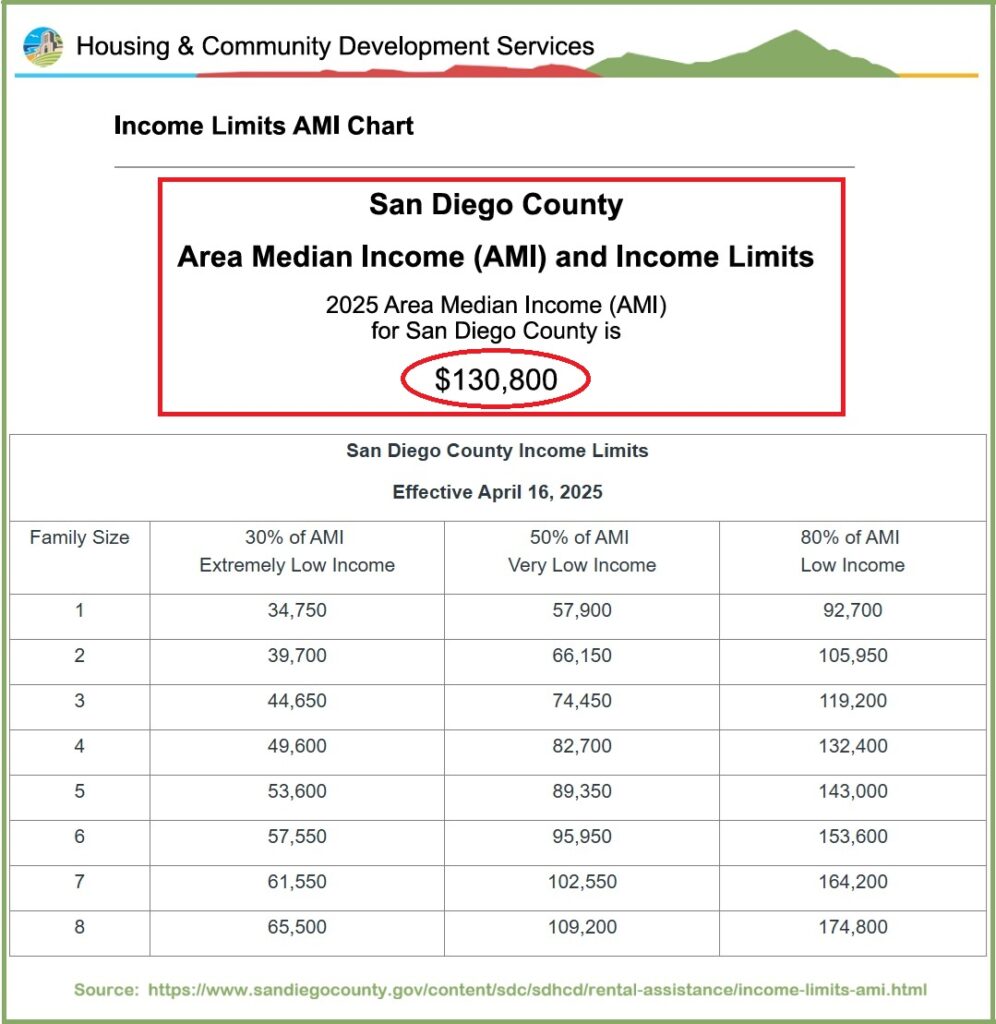
- Eligibility is based on Area Median Income (AMI – see chart below)
- Typical brackets:
- Very low income (~30–50% AMI)
- Low income (~50–60% AMI)
- Moderate income (~80–120% AMI)
EXAMPLE
If a unit is set for 50% AMI (reserved for people who are “very low income”), the rent is capped so someone at that income level can afford it. A single person who makes less than $57,900 per year would be eligible for a “low-income” studio apartment. That person could expect to pay apx. $1,400 per month rent.
How these units get created
Most deed-restricted housing exists because of government rules + incentives:
1. Inclusionary housing rules
- Developers must set aside a % of units as affordable
- In San Diego: often ~10% of units must be income-restricted
2. Density bonus programs
- Developers can build more units, taller buildings, or faster approvals
- In exchange, they include deed-restricted affordable units
3. 100% affordable projects
- Some developments are entirely deed-restricted
- They get major incentives (extra height, density, etc.)
What the restriction actually does
The deed restriction controls things like:
For rentals
- Maximum rent (based on AMI)
- Who can live there (income-qualified tenants)
- Annual income verification
For ownership units (condos, etc.)
- Resale price is restricted
- Buyer must also qualify by income
- You usually can’t sell at full market value
That’s why these units stay affordable long-term.
How long it lasts
- Typically ~55 years in San Diego
- Some programs extend or preserve them even longer (new 2025 preservation efforts)
Who can live in them
To qualify, you generally must:
- Earn below a certain % of AMI (often ≤80%)
- Apply through a housing authority, nonprofit, or property manager
- Sometimes join a waitlist (demand is high)
Big picture (important nuance)
Deed-restricted housing is not the same as “naturally cheap” housing:
- It’s legally required to stay affordable
- It’s often tied to public funding or policy
- Without the restriction, the unit would likely rent/sell at market rates
Pros and tradeoffs
Pros
- Predictable, stable rent
- Long-term affordability
- Often newer, higher-quality units
Tradeoffs
- Strict income rules
- Limited supply / waitlists
- For ownership: limited appreciation (resale caps)
SECTION 8 HOUSING vs. AFFORDABLE HOUSING
1) Section 8 (Housing Choice Voucher Program)
- Officially run by U.S. Department of Housing and Urban Development (HUD)
- You get a voucher that helps pay rent
- You can choose your own housing (as long as the landlord accepts Section 8)
- You typically pay ~30% of your income, and the voucher covers the rest
- Portable: you can move and take the voucher with you (with some rules)
- Limited supply → often long waiting lists
Think of it as: the subsidy follows YOU
There is currently an estimated 10-year wait for Section 8 vouchers in Encinitas.
2) Low-Income / Affordable Housing (Deed-Restricted Housing)
- Usually built or regulated by cities, counties, or developers using government incentives
- Rent is set at a below-market rate based on income limits (e.g., 50%, 60%, 80% of area median income)
- You must apply to a specific property
- If you move, you don’t take the benefit with you
- May still have waiting lists, but they’re property-specific
Think of it as: the subsidy is tied to the UNIT
SAN DIEGO COUNTY INCOME LIMITS CHART (AMI)